In 1942, the British proposed to win the Battle of the Atlantic by building an aircraft carrier out of frozen sawdust.
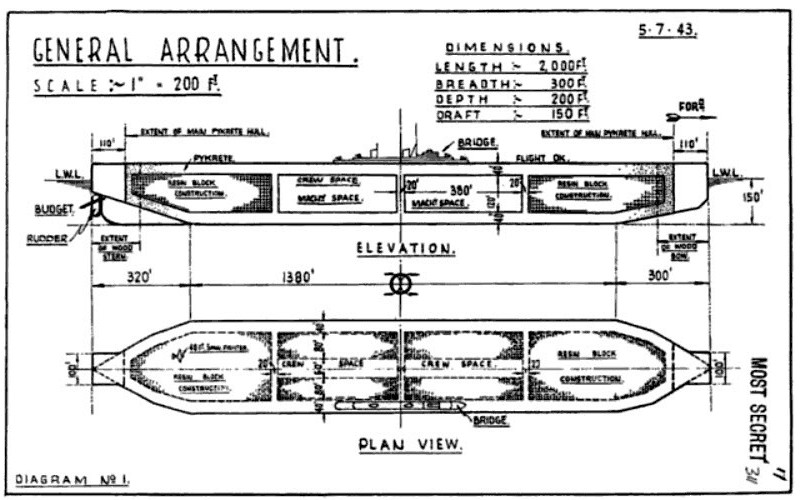
The full-scale ship was supposed to displace around 2 million tons, carry 200 aircraft, and freeze itself stiff somewhere in the mid-Atlantic so fighter planes could launch off the top of it. A 1,000-ton prototype was actually built. Its wreckage is still on the bottom of a lake in the Canadian Rockies.
The idea belonged to Geoffrey Pyke, an eccentric inventor working at Combined Operations Headquarters under Lord Louis Mountbatten. German U-boats were sinking Allied shipping faster than shipyards could replace it, and steel was rationed. Pyke’s proposal was to skip steel altogether. Freshwater is free, water freezes, and frozen water floats.
Plain ice was useless: brittle, prone to cracking, fast to melt. The fix came from Max Perutz, an Austrian-born biochemist who would later win a Nobel Prize for using x-ray crystallography to work out the structure of hemoglobin. Perutz set up a refrigerated lab in a meat locker beneath London’s Smithfield Market and started mixing ice with various fibers. He found that ice frozen with about 14 percent wood pulp became dramatically stronger and slower to melt. The new material was called pykrete, after Pyke.
A block of pykrete will stop a rifle bullet. According to the diaries of Field Marshal Alan Brooke, Mountbatten demonstrated this at a 1943 war conference by firing a pistol at a sample block in the room. The bullet ricocheted and, in Brooke’s words, “buzzed round our legs like an angry bee.”
In January 1943, construction began on a prototype at Patricia Lake, in what is now Jasper National Park. By March, a 60 by 30 foot (18 by 9 m), 1,000-ton model floated on the lake, kept frozen by a single one-horsepower refrigeration unit.
The full-scale ship never got built. By December 1943, costs had climbed from an estimated £700,000 to £2.5 million, and a bigger problem had appeared. Long-range Allied aircraft, particularly the B-24 Liberator, could now cover most of the Atlantic from existing bases. Pykrete carriers were no longer needed.
The underlying materials science was real, though. Pykrete is much harder, much tougher, and far slower to melt than pure ice. Researchers occasionally revisit Perutz’s meat-locker work when studying composite materials, ice-based construction in polar regions, and concepts for cold-climate habitats elsewhere in the solar system.
The Patricia Lake prototype melted and sank once nobody was paying for refrigeration. Its wooden frame, ductwork, and insulation are still down there, at depths of roughly 26 to 43 m (85 to 140 ft). An underwater plaque marks the site, and local dive operators run trips out to it. It is one of the stranger war memorials on Earth: a partly-melted, half-collapsed scale model of a weapon that never had to be used.
Learn more: Perutz, M. F., “I Wish I’d Made You Angry Earlier” (Cold Spring Harbor Laboratory Press, 1998), the memoir essay in which Perutz describes the wartime pykrete work in detail. Wikipedia’s well-sourced overview: https://en.wikipedia.org/wiki/Project_Habakkuk