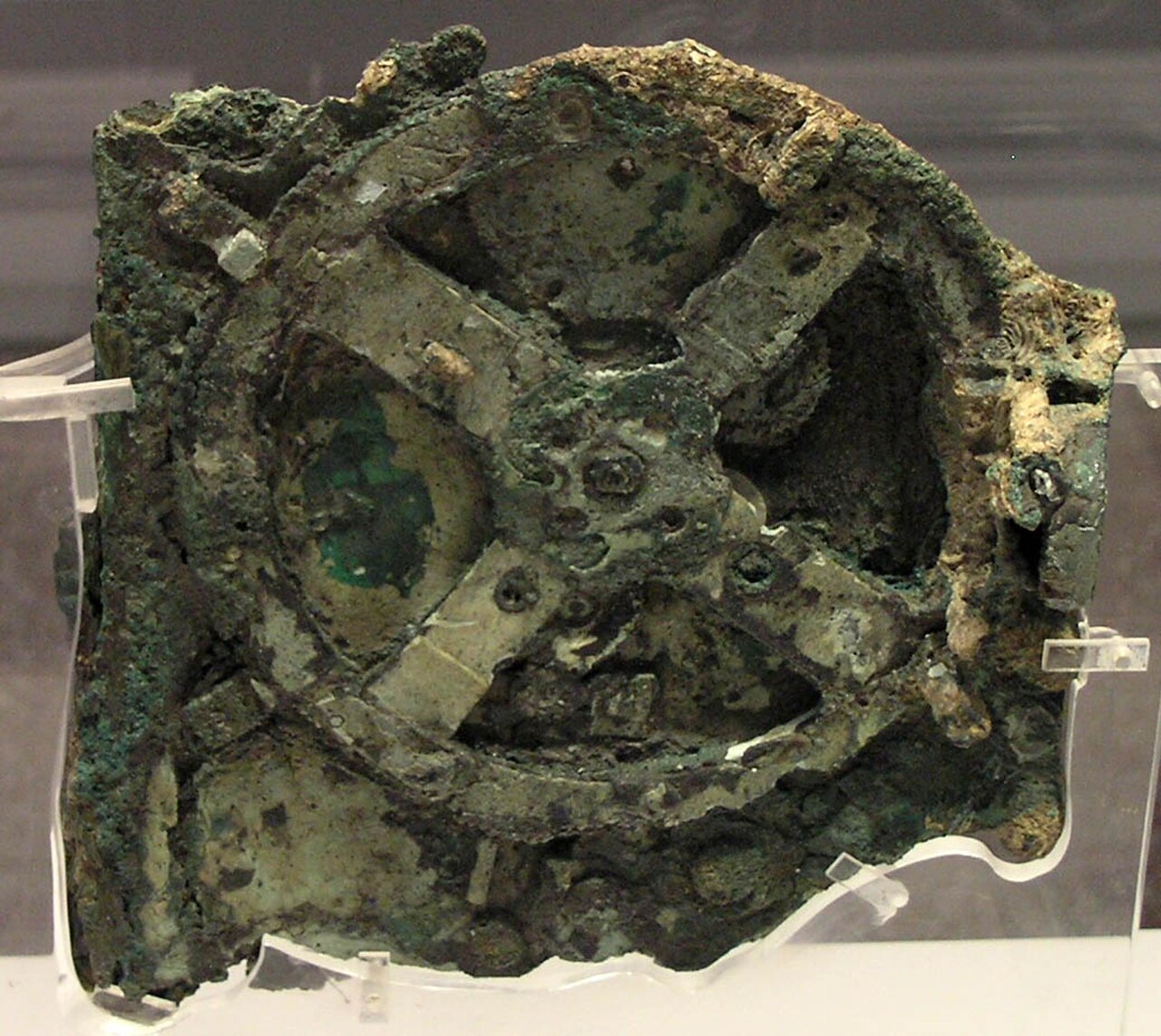
In 1901, a Greek sponge diver surfaced from a Mediterranean wreck shouting that he had just seen a heap of dead naked women on the seafloor. He had not. What he had seen was a pile of bronze and marble statues, scattered across the deck of a 2,000-year-old Roman cargo ship that had gone down with a hold full of looted Greek art. Among the statues was an unremarkable lump of corroded bronze about the size of a large dictionary. Nobody knew what it was.
It turned out to be a computer.
The diver was Elias Stadiatos. The wreck was off the island of Antikythera, where a storm had forced his crew to shelter. The ship had been carrying Greek bronzes and marbles back to Italy around 60 BCE, the spoils of a raid. The corroded lump came up with the rest of the cargo and was sent, with the statues, to the National Archaeological Museum in Athens.
There it sat for decades. Researchers noticed it had gears, which was strange, because sophisticated mechanical gearing was not supposed to exist in the ancient world. The assumption was that it must have been a simple mechanism of some kind: an astrolabe, perhaps, or an astronomical toy. That assumption was spectacularly wrong.
The Antikythera mechanism, as it is now called, was a hand-cranked analog computer. Turn the handle, and a series of at least 30 interlocking bronze gears moved a set of dials on the front and back. One dial showed the position of the sun and moon through the Greek zodiac. Another tracked the Metonic cycle: the 19-year period after which solar and lunar calendars realign. A third predicted solar and lunar eclipses. There was a display showing the four-year cycle of the Panhellenic games, including the Olympics.
The mechanism was made around 200 to 60 BCE, most likely in a workshop on the island of Rhodes, possibly connected to the astronomer Hipparchus, who worked there at roughly the right time.
What makes it genuinely astonishing is the gear ratio required to track the moon’s motion accurately. The moon does not orbit Earth in a perfectly even circle. It moves faster when it is closer (perigee) and slower when it is farther away (apogee). To model this mathematically requires understanding of what is now called elliptical orbital mechanics. The mechanism’s designer solved it mechanically, using a pin-and-slot device that converted uniform rotation into the variable speeds the moon actually travels. This is sophisticated kinematic engineering.
For most of the twentieth century, X-ray and surface examination gave researchers pieces of the picture but not the whole thing. The real breakthrough came in 2005, when a team used three-dimensional X-ray tomography to see inside the corroded mass without destroying it. The scans revealed gear teeth, scale markings, and most importantly, fragmentary inscriptions on the mechanism itself: a manual, in Greek, explaining what each dial meant and how to use it.
Later analysis, published in 2021, used polynomial texture mapping to recover more of the inscriptions and showed that the front display included a planet tracking system for all five planets visible to the naked eye, each requiring its own gear train. The mechanism was more complex than anyone had realized.
Nothing comparable has been found from the ancient world. The next devices with similar mechanical complexity appear in medieval Europe, more than a thousand years later. What happened to the knowledge, whether it was lost in the contraction of the Roman Empire or simply never widely transmitted, is unknown.
Someone made this. Someone understood the sky well enough to model it in bronze, and then packed it on a ship, and the ship sank, and the knowledge sank with it.