Without Einstein, your phone would not be able to tell what country you were in.
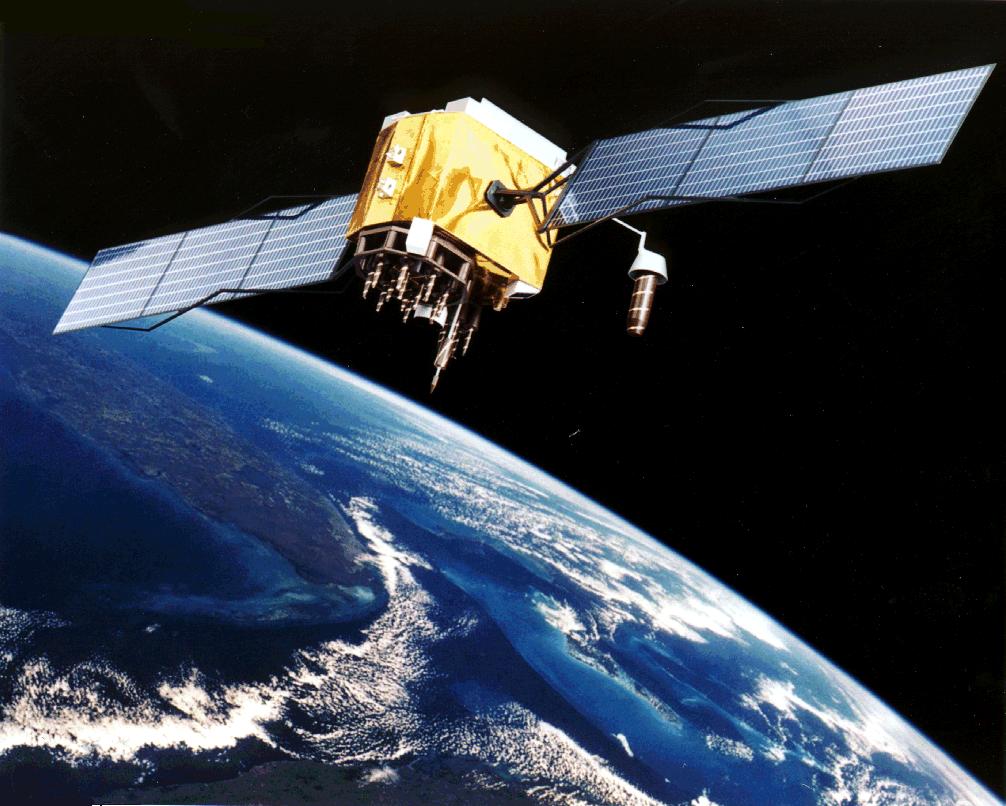
GPS works by listening to at least four satellites overhead, each broadcasting a precise timestamp from an onboard atomic clock. Your phone measures the tiny differences in when each signal arrives (light travels about 30 centimeters in a nanosecond, so the timing has to be extremely precise), calculates its distance from each satellite, and triangulates a position. The math is straightforward. The physics underneath it is not.
The problem is that the satellite clocks and the ground clocks are not running at the same speed. Two different effects pull them apart, in opposite directions, for two completely different reasons, both of them Einstein’s. Without correcting for both, GPS would drift by roughly 10 kilometers a day.
GPS satellites orbit at approximately 20,200 kilometers altitude.
The first effect comes from special relativity. GPS satellites travel at roughly 3.87 kilometers per second relative to Earth’s surface. According to special relativity, moving clocks run slow. A satellite clock, moving at that velocity, ticks about 7 microseconds slower per day than an identical clock on the ground.
The second effect comes from general relativity. Clocks in stronger gravitational fields run slower than clocks in weaker gravitational fields. Earth’s surface is deeper in a gravitational well than orbit. A satellite clock, farther from Earth’s mass, runs about 45 microseconds faster per day than a surface clock.
The two effects work in opposite directions. Combined, GPS satellite clocks gain approximately 38 microseconds per day relative to Earth-surface clocks.
Thirty-eight microseconds is a very small number. But the GPS system uses timing to calculate distances, and light travels 11.4 kilometers in 38 microseconds. Without correction, your GPS position would drift by around 11 kilometers per day, compounding, in a random direction. Within a week of running uncorrected, civilian GPS would be useless for navigation. Within a month, you would not be able to tell which country you were in.
The engineers who designed GPS in the 1970s knew this. There was internal debate about whether to correct for relativistic effects: some engineers felt that the corrections were small enough that they could wait and see if they mattered in practice. Others, citing the theoretical values, insisted the corrections had to be built in from the start. The latter group won. The satellite clocks were deliberately set to run at a slightly different frequency before launch, a frequency adjusted to compensate for the 38-microsecond-per-day gain they would experience in orbit. When the system went live, it worked.
This made GPS one of the first technologies that could not function without relativistic physics. Special and general relativity are not abstract academic concerns. They are engineering requirements for any precision timing or navigation system operating at high velocities or different gravitational potentials.
There is an additional wrinkle. The Earth is not a perfect sphere, and gravitational field strength varies slightly across the surface. The GPS system has to account for these variations as well. The full relativistic correction model used by the system includes terms for the oblateness of the Earth and the variation of gravitational potential with latitude.
The thing in your pocket that tells you which way to turn is doing tensor calculus, continuously, as a side effect of functioning.