There is a 600-year-old book in the rare-book library at Yale, written in a language nobody can read, illustrated with plants that do not exist on Earth. NSA analysts took a run at it during the Cold War. Linguists have worked on it for a century. Modern AI has analyzed every page. Not a single word has been convincingly decoded.
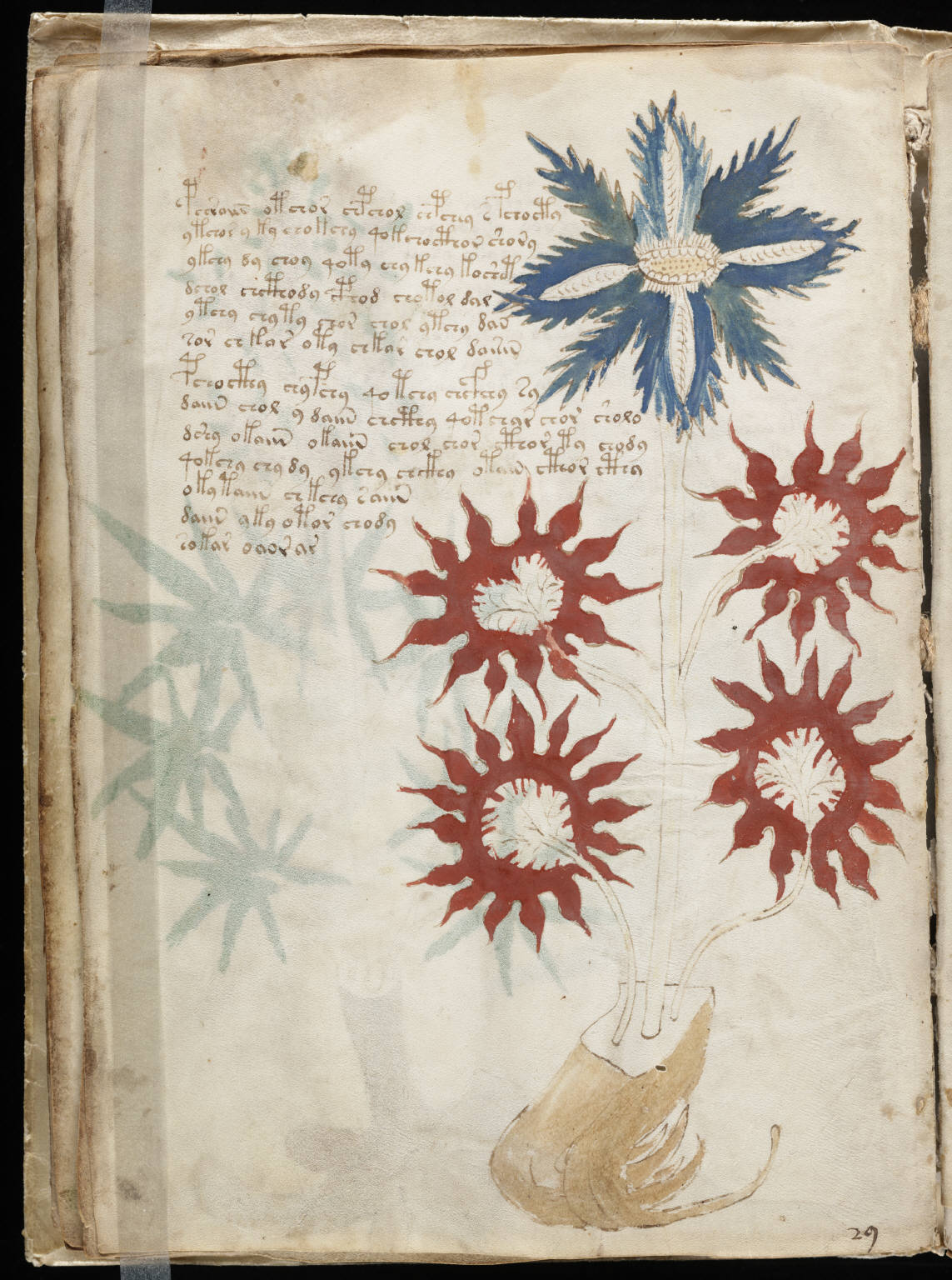
The Voynich manuscript runs about 240 pages, written by hand on vellum that carbon-dates to somewhere between 1404 and 1438. The text uses an unknown script with 20 to 25 distinct characters. The illustrations include the impossible plants, astronomical diagrams that match no known tradition, and a section showing naked women in networks of connected tubes and pools that nobody can interpret.
The manuscript was discovered in a chest of old books at the Villa Mondragone near Rome in 1912 by antiquarian book dealer Wilfrid Voynich, who purchased it and gave it his name. It now lives at the Beinecke Rare Book and Manuscript Library at Yale University, where it is catalogued as MS 408. High-resolution scans are publicly available, so anyone in the world can study it.
The illustrations are strange in specific ways. The botanical section shows plants that do not correspond to any known species. Some are plausible-looking composites of real plants; others appear entirely invented. The astronomical section contains circular diagrams that may represent star charts or calendars, but the symbols do not match any standard astrological or astronomical tradition. The balneological (bathing) section shows naked women in networks of connected tubes and pools. No one knows what this section depicts.
Linguists have established that the text has properties consistent with natural language: it follows statistical patterns (letter frequency, word length distribution, a pattern called Zipf’s law) that gibberish does not. This suggests either a real language, a constructed language, or a very sophisticated cipher. But it does not match any known language.
Several credible-sounding decipherments have been announced over the years. In 2004, a computer scientist claimed it was a phonetic transcription of a Latinized Arabic dialect. In 2014, a researcher proposed it was a simplified Latin. In 2019, an academic claimed it was an extinct dialect of proto-Romance. Each of these received press attention and each was subsequently rejected by the scholarly community for failing to produce coherent translations of even a substantial portion of the text.
AI analysis has added new tools but not new answers. Statistical analysis of the text using neural networks confirms the language-like properties but cannot identify the source language. One analysis found statistical similarities between Voynich and East Asian languages, but no one has made a convincing case that the manuscript was written by someone from that tradition.
The two most defensible positions are that it is either an unknown natural language (perhaps a now-extinct Central Asian or Middle Eastern tongue written phonetically) or an elaborate hoax designed to look like a coded manuscript, possibly to sell to a credulous buyer. The hoax hypothesis is taken seriously by some researchers.
The manuscript has no known provenance before the 17th century, when it appeared in a letter to a Jesuit scholar. The letter claimed it had been purchased by Holy Roman Emperor Rudolf II for 600 gold ducats. Whether that is true is unknown.
The thing sits in New Haven, waiting, and the world’s best pattern-recognition systems have looked at it and found the pattern impenetrable.