At 7:17 in the morning on June 30, 1908, witnesses across a vast stretch of central Siberia reported a column of bluish light, as bright as the sun, crossing the sky. Minutes later, a flash and a sound like artillery. The shockwave knocked people off their feet 60 kilometers away. Windows shattered 400 kilometers distant. The explosion registered on seismographs across Europe and Asia. Atmospheric pressure waves circled the globe twice.
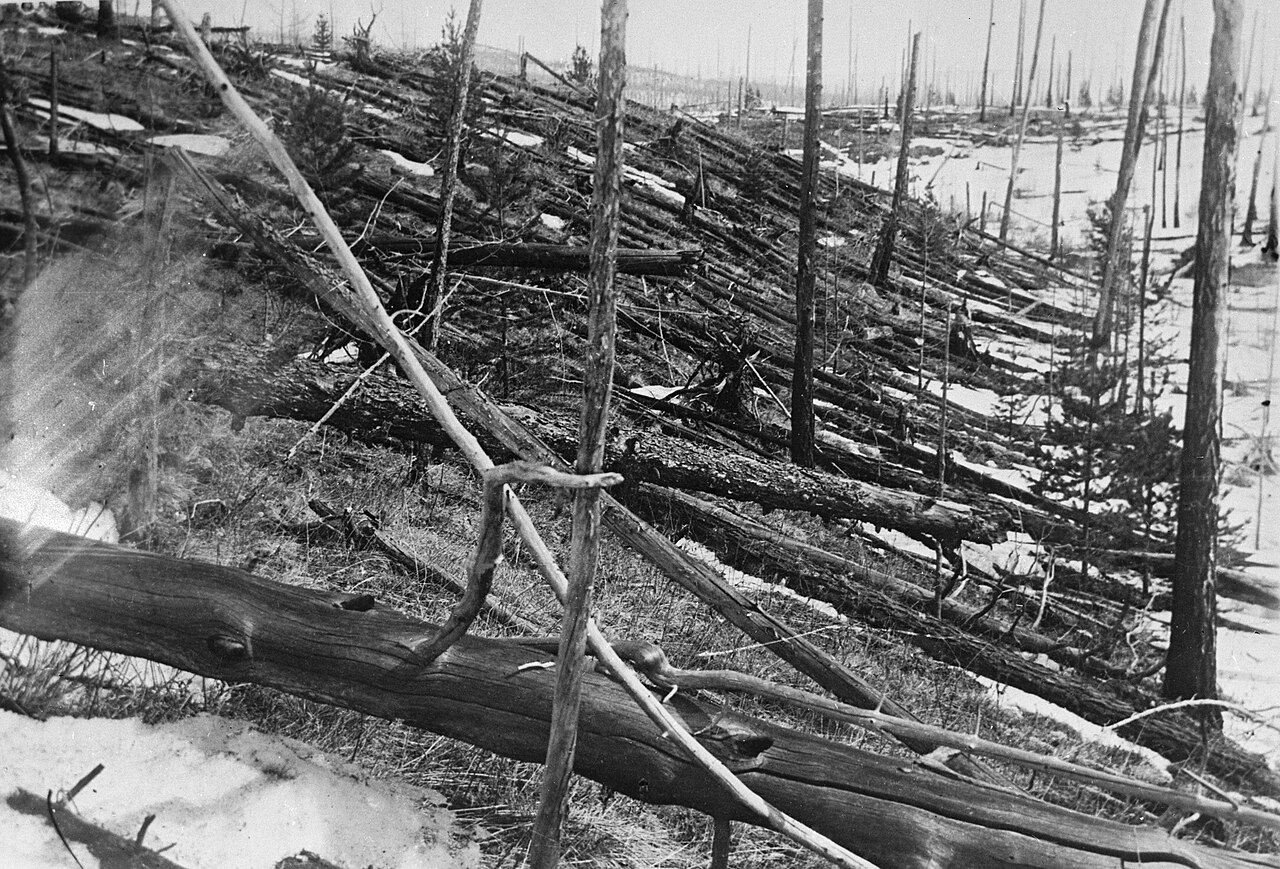
In the Tunguska River basin, an area of remote boreal forest in what is now Krasnoyarsk Krai, 2,150 square kilometers of trees had been flattened, all pointing radially outward from a central point. The pattern, visible from the air decades later, looked like a butterfly wing: elongated in the direction of the object’s approach. Roughly 80 million trees were knocked down.
There was no crater. There were no meteorite fragments.
The remoteness of the site, combined with the political chaos of Russia in the years after 1908 (revolution, civil war, another war), meant the first scientific expedition to reach the area came in 1927, nearly two decades later, led by Russian mineralogist Leonid Kulik. Kulik expected to find a massive meteorite. He found a flattened forest, local accounts of extraordinary phenomena, and nothing at the center that explained it.
The absence of a crater and of significant meteorite material pointed toward an airburst: an object that entered the atmosphere and exploded before reaching the ground. The fireball could have been a comet, a rocky asteroid, or a fragment of either. For decades, debate divided between the comet and asteroid hypotheses, with various exotic alternatives periodically proposed, including a miniature black hole passing through Earth (testable and falsified), antimatter annihilation (also falsified), and a crashed spacecraft.
The turning point came in the 1990s and 2000s with more sophisticated analysis. Researchers examining soil and tree resin from the site found microscopic spherules of magnetite and silicate glass with compositions consistent with a stony asteroid. The absence of large fragments suggested a relatively fragile object that had largely vaporized in the explosion. Computer modeling of the explosion pattern, combined with analysis of the flight path, converged on a picture of a rocky body approximately 50 to 80 meters in diameter entering the atmosphere at roughly 15 kilometers per second and exploding at an altitude of 5 to 10 kilometers.
A 2013 paper in the journal Planetary and Space Science, using updated modeling and the evidence from the site, gave the most complete reconstruction to date: a stony asteroid, roughly 60 meters wide, releasing around 10 to 15 megatons of energy in an airburst. For comparison, the Hiroshima bomb released about 0.015 megatons. Tunguska was roughly 1,000 times more powerful.
Objects in this size range hit Earth every few centuries on average. Tunguska was lucky in one respect: it hit one of the least populated regions on the planet. The same event over London or Shanghai would have been the worst natural disaster in recorded history.
The event is now considered solved, at least in broad terms. What is genuinely uncertain is when the next one comes.