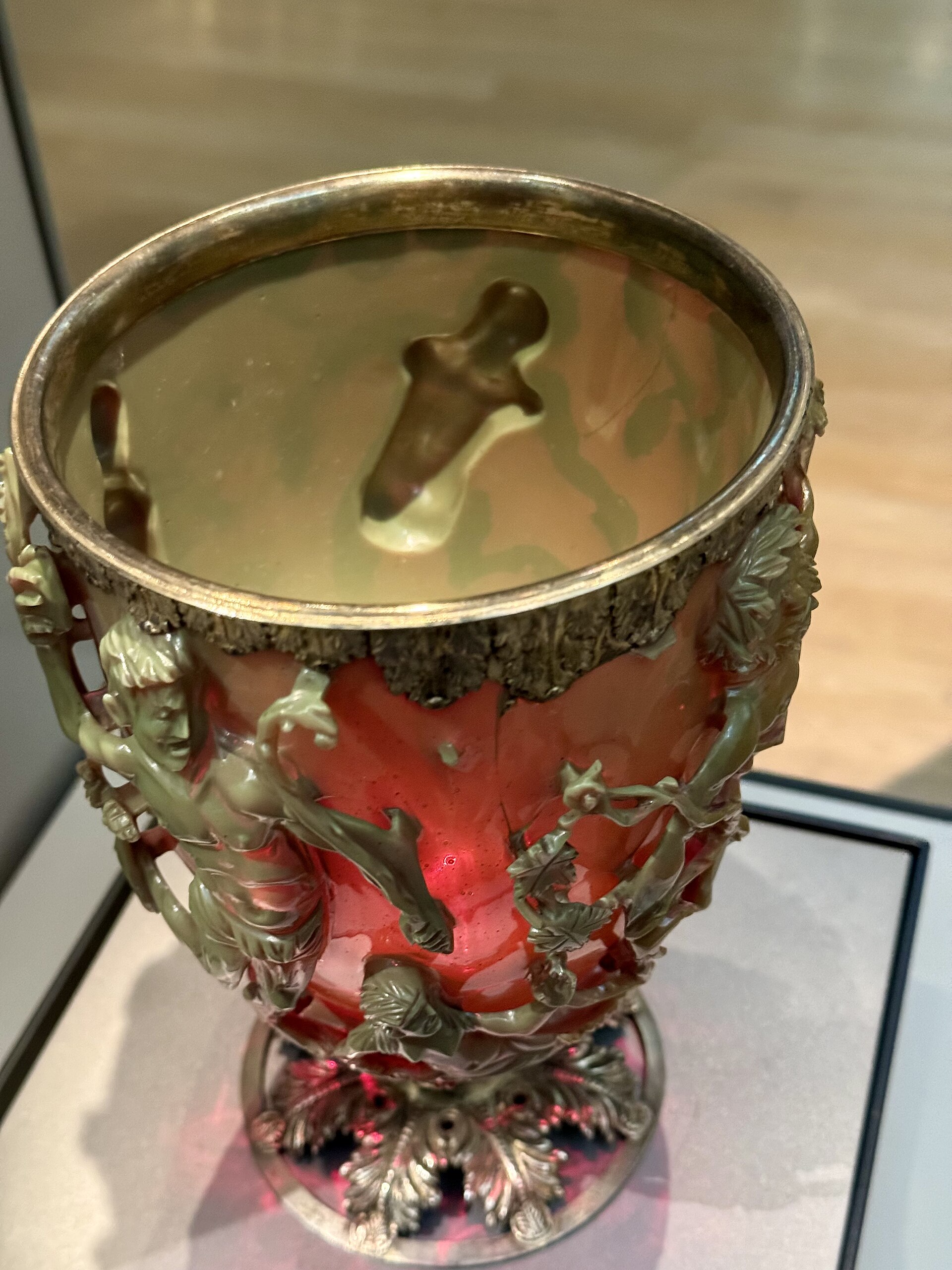
Shine a light at the Lycurgus Cup from the front, and it glows opaque green like jade. Move the light behind it, and the cup turns translucent red. The same cup. The same glass. The color depends entirely on which side the light is coming from.
It was made by a Roman glassworker around the year 300, sat in private collections for centuries, and ended up in a case at the British Museum. The reason it changes color is nanotechnology, and the Romans almost certainly had no idea they were doing it.
The cup is small, about 16 centimeters tall (six inches), and carved in a Roman style called a cage cup. A scene from Greek myth wraps around the outside: King Lycurgus of Thrace, who had insulted the god Dionysus, being strangled by vines. The British Museum bought it from Victor, Lord Rothschild in 1958 for £20,000.
The dichroism, the color-shift, was noted from the start, but for decades nobody could explain it. Early researchers in the 1950s confirmed the cup was glass, not some hybrid material. The mechanism stayed a mystery until 1990, when British Museum scientists Ian Freestone and Nigel Meeks put a fragment under an electron microscope and found the answer. The glass contains a sprinkling of metallic particles, mostly a gold-silver alloy with a little copper, around 70 nanometers across. That is roughly one thousandth the width of a human hair.
Particles that small interact strangely with light. Photons hitting the front of the cup scatter off the gold-silver clusters and bounce back in mostly green wavelengths. Photons passing through the glass have their green wavelengths absorbed by the particles and let the red wavelengths through. So one cup, lit from different sides, plays the trick of being two different colors at the same time.
The amounts of metal involved are tiny. The glass contains roughly 330 parts per million of silver and 40 parts per million of gold. A pinch of metal, dispersed at the right scale, does the entire job.
This puts the working knowledge of nanoparticle optics about 1,600 years earlier than the field of nanotechnology had assumed. The Lycurgus Cup is not a one-off oddity either. Medieval European stained-glass workshops produced ruby-red glass using gold particles by the same general mechanism, probably without understanding why it worked any better than the Romans did. The trick was passed down as a recipe, not a theory.
Modern researchers now study the same physics on purpose. Nanoparticle-doped glass is being tested as a high-sensitivity chemical sensor: tiny changes in what is in the surrounding liquid shift the color visibly. The Romans built one by accident, about 1,700 years too early to know what it was.
The Lycurgus Cup is the only intact Roman piece of dichroic glass we have. Whether ancient glassworkers could reproduce the effect reliably, or stumbled into it once and lost the recipe, is genuinely unclear. The composition is so specific (the gold-silver-copper ratio, the firing temperature, the cooling rate) that most modern attempts to replicate it fail. We can describe what the Romans made. We cannot quite do it again.
Learn more: Freestone, I., Meeks, N., Sax, M. and Higgitt, C., “The Lycurgus Cup: A Roman Nanotechnology,” Gold Bulletin 40 (2007), pp. 270-277. https://link.springer.com/article/10.1007/BF03215599
British Museum object record, drinking-cup (1958,1202.1). https://www.britishmuseum.org/collection/object/H_1958-1202-1