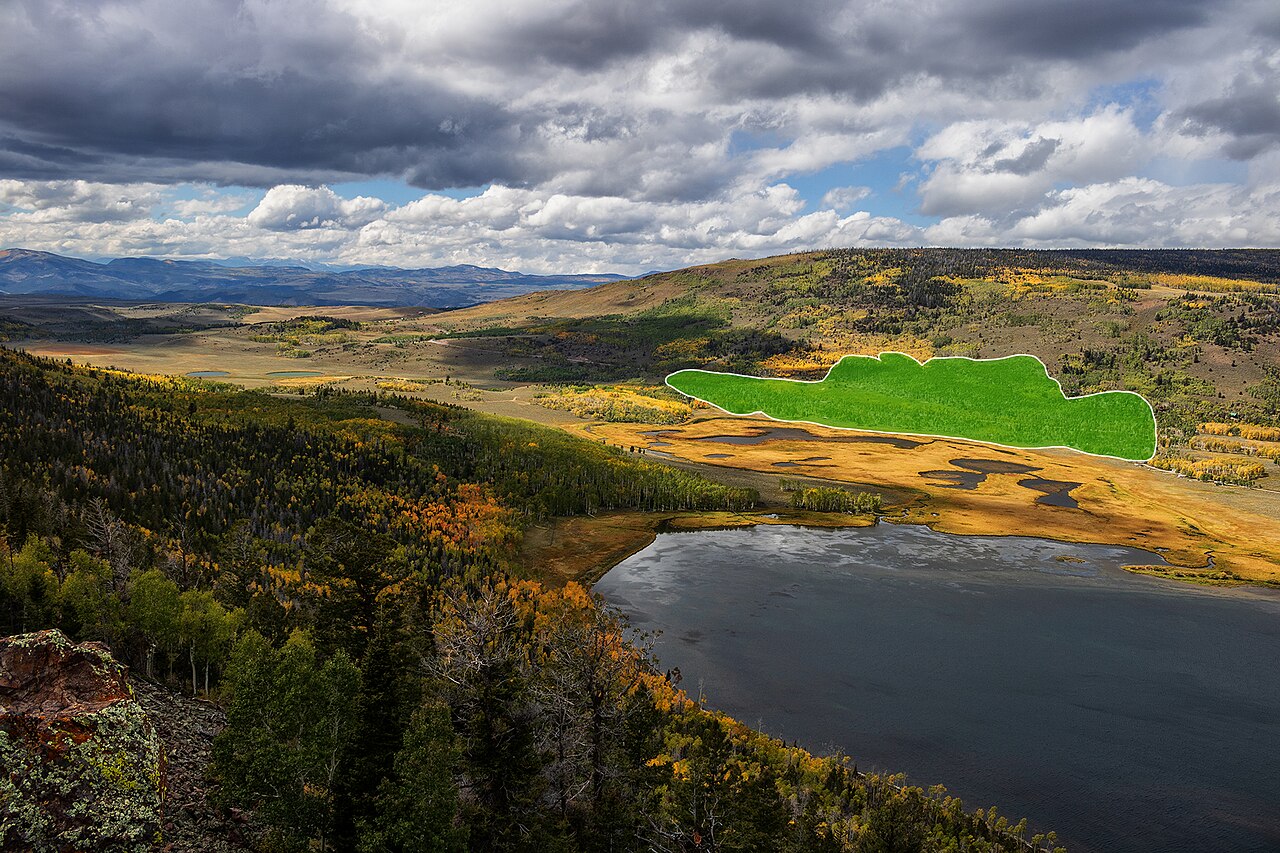
The Fishlake National Forest in Utah contains what appears to be a stand of quaking aspen trees, trembling-leafed, white-barked, the kind that flicker gold in autumn and make the sound that gives the species its name. What it actually contains is a single organism.
The grove is called Pando, from the Latin for “I spread.” It covers about 43 hectares and contains roughly 47,000 individual tree trunks. All of them are connected to a single massive root system and are genetically identical. Every trunk that exists in Pando is a clone of the original, grown from a root sucker rather than a seed. The organism weighs an estimated 6,000 metric tons, making it by mass the largest known living thing on Earth.
Pando is old. The root system began growing sometime after the last glaciation, which ended roughly 10,000 to 12,000 years ago, possibly much longer ago than that. The age is difficult to establish precisely because the above-ground trunks are relatively short-lived (individual aspens typically survive 100 to 150 years), but the root system can persist and produce new trunks indefinitely. Some estimates place Pando at 80,000 years old, though this is contested; a conservative estimate of at least 10,000 years is widely accepted.
The organism is one because it meets the biological criteria: a single genetic individual, with all parts sharing the same nuclear DNA and connected by a continuous living structure. When researchers examined the genetics of samples from across the grove in the 1990s, they found no genetic variation among the trees: all clones, all the same organism.
How we know it is one organism is also interesting. Quaking aspen reproduces sexually (by seed) under some conditions and clonally (by root suckering) under others. In the wake of disturbances like fire, which kills above-ground portions but leaves roots intact, the root system sends up thousands of new shoots. The problem for identifying clones is that different clonal stands can grow near each other and look identical. Genetic analysis sorted this out by showing that Pando’s 47,000 trunks share genetics that neighboring groves do not.
The problem now is that Pando is shrinking.
A 2018 study by researchers at Utah State University found that the regeneration of new trunks had failed almost entirely across the grove, while existing trunks were dying at a normal rate. The culprit is a combination of factors: overgrazing by cattle and deer, which eat new shoots before they can grow into trunks; a drought-related stress that makes regeneration harder; and, possibly, fire suppression over the past century, which has reduced the large-scale disturbance events that historically triggered mass resprouting.
The 2018 study found that Pando had lost significant area in recent decades and that if current trends continued, the organism could die within a human lifetime. Management efforts, including fencing to exclude grazers, have shown some success in allowing regeneration within protected areas. Whether those efforts are sufficient to stabilize the organism at its current scale is unclear.
The oldest, heaviest, most spread-out living thing on Earth is struggling. The thing threatening it is something as small as a deer eating a sapling.